|
1. Q: What pipettors are compatible with the Diffinity RapidTip?
A: The RapidTip currently uses a ‘universal’ tip that best fits Benchmate, Biohit, Eppendorf, Oxford, and Pipetman standard pipettors. We have also had customers use Alphapette, Finnpipette, Gilson/Genemate, Labnet, and Rainin traditional pipettors with successful results. At this time the RapidTip is not compatible with Rainin LTS pipettors.
2. Q: What PCR sample volume can be purified with a single tip? Is there any sample loss?
A: The RapidTip is currently optimized to purify 25 microliter PCR samples and can purify 20-30 microliters with good results. If your sample is less than 20 microliters and at a higher concentration, you may be able to dilute to 25 microliters prior to purification with good results. Typically up to 5 microliters of volume can be lost inside the tip.
3. Q: Do all 96 RapidTips need to be used at the same time?
A: No, you do not need to use all 96 RapidTips at the same time; you can use as many as you need and store the remainder in the box on your bench or shelf at room temperature. RapidTip packaging was designed to be flexible since many researchers purify different numbers of samples.
4. Q: What is the shelf life of RapidTips?
A: RapidTips have a shelf life of 1 year.
5. Q: Does the RapidTip purify PCR prior to TOPO cloning?
A: TOPO cloning typically requires removal of primers and primer-dimers from a PCR reaction. The RapidTip removes nucleotides, primers, and primer-dimers (DNA smaller than 45-50 bp) so it should work well for TOPO cloning.
6. Q: Where in a typical PCR purification pipeline is the RapidTip used?
A: The RapidTip is used for post-PCR purification – it can replace the typical spin column, enzymatic, or magnetic kits that are used for PCR purification. The RapidTip removes DNA impurities (nucleotides, primers, and primer-dimers < 45-50 bp) from the PCR reaction while leaving the PCR amplicon (>100bp), salt, and polymerase in solution. Salt and polymerase do not interfere with downstream reactions such as Sanger sequencing in our extensive tests (salt and enzymes are also present in Exo-SAP treated PCR).
Below find an outline of a typical workflow. Step 3 (italics) is the correct place to use RapidTip.
1. DNA Extraction: Extract from tails, tissue, bacteria, etc. Purification may or may not be included in all protocols.
2. PCR amplification: Use genomic, plasmid, or other template DNA from (1) to amplify the region of interest.
3. RapidTip Purification: Use the Diffinity RapidTip to remove dNTP, primer, and primer-dimer from your PCR reaction – the PCR amplicon will remain in solution.
4. BigDye Reaction: Use RapidTip purified PCR amplicon from (3) as template for your sequencing reaction.
7. Q: Can the RapidTip be used to purify PCR products 50-99 bp long?
A: The RapidTip will purify 50-99 bp PCR products but with the lower yields outlined below:
• 50-75 bp: ~50% yield/recovery of dsDNA
• 75-99 bp: ~65% yield/recovery of dsDNA
Because the RapidTip removes significant amounts of dsDNA between 50 and 99 bp, the amount recovered may not be sufficient for all downstream applications – it will depend on the initial or starting DNA concentration as well as the amount of DNA necessary for downstream applications (which varies between researchers).
8. Q: Does the RapidTip retain large single-stranded DNA (100-200 bp) such as probes for in situ hybridization?
A: The RapidTip has not been validated for use to recover large single-stranded DNA, however large single-strands typically self-hybridize at room temperature, which could form structures similar to dsDNA between 50 and 99 bp. If that occurs, the yield may be lower as outlined below:
• 50-75 bp: ~50% yield/recovery of dsDNA
• 75-99 bp: ~65% yield/recovery of dsDNA
Individual researchers will need to determine if recovery is sufficient for downstream reactions.
9. Q: Has the RapidTip been used in library preparation for next or second generation sequencing (SOLiD, 454, Solexa, etc?)
A: At this time, the RapidTip has not been validated for use for next or second generation sequencing library preparation. The RapidTip has been validated for use to purify PCR samples prior to Sanger sequencing. If you’re interested in testing the RapidTip for library preparation, please contact us for more information: rgaborski@diffinitygenomics.com
10. Q: What are some of the benefits of the Diffinity RapidTip product?
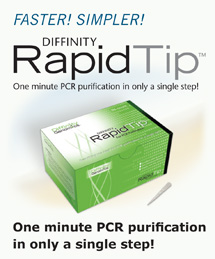
A: The RapidTip provides a dramatic reduction in purification speed and ease of use while providing excellent yield and purity. Other benefits of the RapidTip include:
• Extremely rapid purification – only one minute (purify 8 or 12 reactions in one minute by using a multichannel pipettor)
• Removes up to 90% of the impurities (dNTPs, primers, primer-dimers)
• Recovers up to 90% of dsDNA
• Minimal labor (simple, one-step protocol)
• Easy to learn (pipetting is ubiquitous and doesn’t require extensive training of existing and new personnel)
• Handles large fragment length – 100 bp to 10 kb
• No special storage conditions (room temperature storage - doesn’t require refrigeration or freezer space)
• Small storage footprint (RapidTip comes in a standard pipette tip box)
• No special handling (no reagents, just pipette to mix)
• No special or capital equipment (beyond a simple pipettor)
• Minimal waste (only the tip is disposed after use)
11. Q: Is the RapidTip compatible with PCR mastermixes and supermixes?
A: The RapidTip has not been validated for use with all pre-mixed PCR master or supermixes and we cannot guarantee that performance with a specific master or supermix will be the same as with standard PCR components. Tests have shown that some detergents (surfactants) and dyes can cause bubbling and additional volume loss without a loss in purification performance. The RapidTip may not always remove loading dye present in a PCR product. Validation is ongoing – if you have a question regarding a specific mix, please contact us: rgaborski@diffinitygenomics.com
12. Q: Is the RapidTip re-usable?
A: The RapidTip is a single-use purification product and is optimized to purify a single 25 microliter (+/- 5 microliter) PCR reaction.
13. Q: How do I measure DNA recovery?
A: To estimate percent recovery, analyses of the samples pre-purification and post-purification arenecessary. For this process, we recommend either a PicoGreen®2 type assay or visualizationon agarose gel.
PicoGreen: The PicoGreen assay uses an intercalating dye to specifically quantitate only double-stranded DNA. When taking a PicoGreen reading pre-purification, PCR primers and dNTPs will not falsely inflate the reading. This enables a more accurate quantification of recovery.
Agarose Gel: In addition to PicoGreen readings, visualization of the sample pre- and post-purification on agarose gel along with a DNA Ladder/Marker for accurate size and mass estimations (quantitation) of nucleic acid fragmentsis recommended, but would be more subjective. For most accurate results, run both pre- and post-purified samples on the same gel to minimize differences in electrophoresis parameters and imaging processes.
Spectrophotometric analysis using Optical Density (OD) at 260 nm is discouraged because at 260 nm, in the post-purified sample, any remaining single-stranded primers and dNTPs (expected to be in very small amounts that will not affect Sanger sequencing) and other interfering chemical substances from the plastics in pipette tips that show fluorescence at this wavelength will contribute to the overall absorbance reading, giving an incorrect quantification of desired PCR product.
|