Try a Sample
Get A FREE T-Shirt


News Updates

01-15-2013 Congratulations to Matt H. from Regeneron who won the Ipod Nano from Diffinity Genomics at SLAS20113!

01-11-2013 Diffinity Genomics Strengthens Senior Leadership by Hiring New President

11-23-2012 High Tech Rochester and Venture Creations Fuel Growth - Diffinity Genomics is one of the businesses referenced! 

08-30-2012 Diffinity RapidTip for PCR Purification (96) Available to purchase in the NIH Supply Center!

08-23-2012 Diffinity Genomics Awarded Two NIH Grants Totaling $700K

Upcoming Life Science Exhibits

April 10: University of Virginia, Charlottesville, VA  
April 11: Georgetown University, Washington DC
April 17: University of Rochester, Rochester, NY

Molecular Diagnostics

Home / Technology / DNA Purification / Molecular Diagnostics
 

Diffinity’s selective adsorption technology can be used to create a hybridization assay for molecular diagnostic testing.  The technology is compatible with existing laboratory-based and point-of-care diagnostic systems.  It also enables the development of simple, inexpensive and rapid chip-based diagnostic systems.

Unlike many other hybridization assays, Diffinity Technology can be configured such that the hybridization step is independent of the assay so that molecular recognition (i.e. duplex formation) occurs rapidly under ideal conditions specified by the user and without the performance limiting constraints associated with hybridization at surfaces.

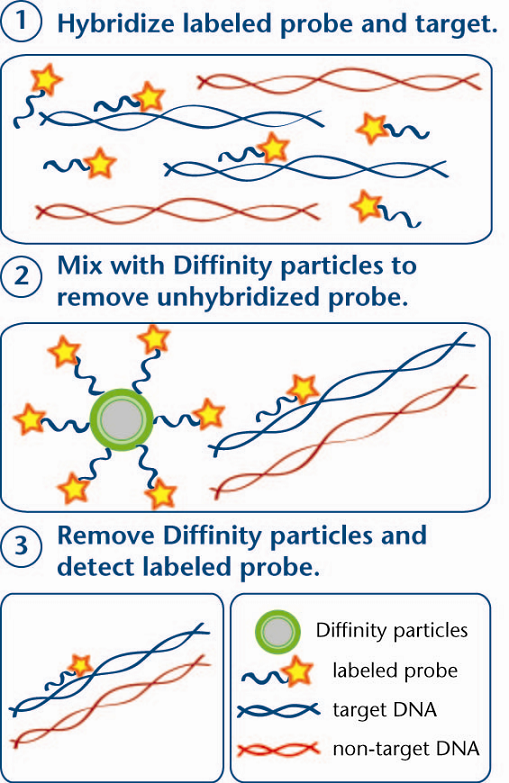
When a fluorescently-tagged probe of ss-DNA does not match a sequence in a target analyte, the fluorescently-tagged probe adsorbs on a Diffinity proprietary particle and its fluorescence is immediately quenched.  If the probe sequence is able to hybridize to the target, it will not adsorb on the particle and its fluorescence persists. Therefore, fluorescence indicates the presence of target sequence in the analyte. The amount of fluorescence is proportional to the amount of target present and enables quantitative measurements.

Schematic:  Hybridization Assay


Diffinity proprietary particles can be used in a DNA hybridization assay to detect specific sequences that hybridize to a labeled probe (fluorescent, electrochemical, or radioactive).